Start with load, not cost
Carbon steel is the default for a reason. It is strong, it is forgiving to weld, it takes impact without cracking and it is the cheapest of the three per pound. For structural work, frames, brackets, supports and anything that will get hit, it is usually the right answer before anything else is considered.
Its weakness is corrosion. Bare steel in weather or washdown starts rusting immediately, so a steel part almost always implies a coating, and a coating implies surface preparation.
When aluminum earns its price
Aluminum costs more per pound and it is lighter, which is the trade people notice first. The one that matters more is that it does not rust.
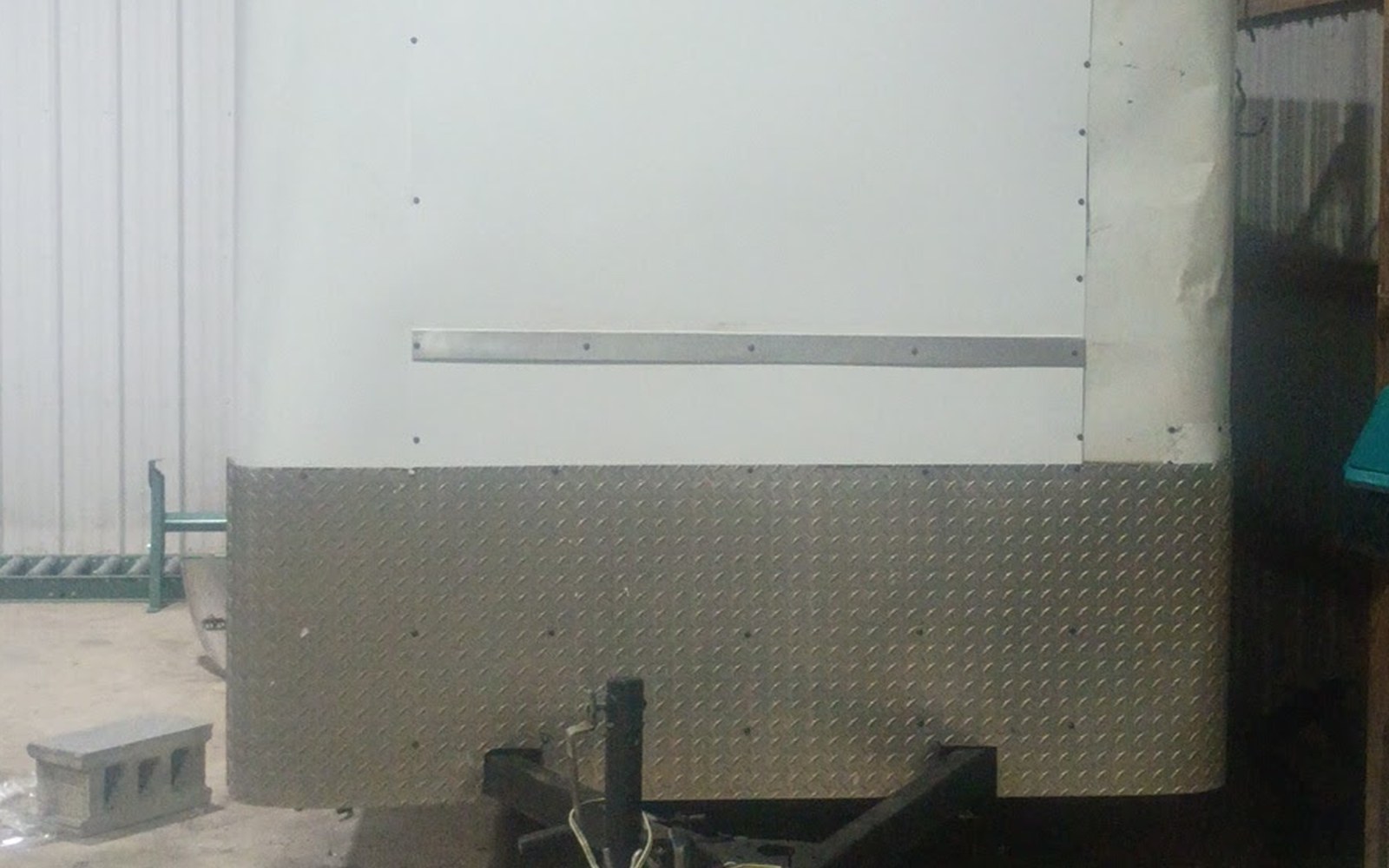
It suits parts where weight is a real cost. On a truck body or a trailer, every pound of structure is a pound of payload you cannot carry, and that compounds across the life of the vehicle.
It also suits parts that live outdoors and would otherwise need recoating on a schedule. Aluminum forms its own oxide layer and stops.
The cautions are honest ones. It is softer, so it takes damage more easily. It is less forgiving to weld and needs more control over heat. And it loses strength faster as it heats up, which matters near anything hot.
Where stainless is the only answer
Stainless is the expensive choice and it is not primarily a strength decision. It is a surface decision.
If the part will be washed down, sit in a food or process environment, contact chemicals, or simply has to stay clean and be seen to stay clean, stainless is doing a job the other two cannot.
It is worth knowing that stainless is not one material. The grades behave differently in different environments, and a shop should ask what the part will actually be exposed to rather than assuming.
| Property | Carbon steel | Aluminum | Stainless |
|---|---|---|---|
| Relative material cost | Lowest | Higher | Highest |
| Weight for the same strength | Heaviest | Roughly a third the density | Similar to carbon steel |
| Corrosion behavior | Rusts, needs coating | Self-protecting oxide, no coating required | Highly resistant, grade dependent |
| Impact tolerance | Best | Dents and deforms more easily | Good |
| Welding | Most forgiving | Needs tighter heat control | Needs heat and contamination control |
| Typical fabrication use | Frames, brackets, supports, structure | Truck and trailer bodies, decks, racks, anything lifted | Washdown, food, process, chemical exposure |
| Hidden cost | Blasting, coating and recoating over its life | Higher material, usually no coating cycle | Material and slower fabrication |
The four questions that settle it
- What load does it carry, and does anything hit it? Impact pushes towards steel.
- What is the environment? Weather, washdown, chemicals or salt push away from bare steel.
- Does weight cost you anything? On vehicles and anything lifted by hand, it does.
- How will it be finished? A steel part that will be coated needs blasting and coating built into the price. An aluminum or stainless part often does not, which narrows the real cost gap more than the raw material price suggests.
The four questions that settle material choice
Impact and abuse push towards carbon steel. Static load is easier to satisfy in any of the three.
Weather, washdown, salt or chemicals push away from bare steel.
On vehicles, on anything lifted by hand and on anything that has to be carried up, it does.
A steel part that will be coated carries preparation, coating and eventual recoating. That is part of its price.
This is the question that usually settles on stainless.
Why the finishing question changes the maths
People compare material prices per pound and stop there. That comparison is usually wrong, because it prices the metal and not the part.
A carbon steel part that has to survive outdoors carries the cost of preparation and coating, and it carries the cost of doing that again in a few years. An aluminum part often carries neither.
Preparation is also where coatings quietly fail. Paint does not fail because the paint was bad nearly as often as it fails because it went onto scale, rust or oil. If a steel part matters, the blasting is not the optional part of the job.
 Stock
StockCoatings do not fail because the paint was bad. They fail because it went onto dirty metal.
Galvanic corrosion, the mistake that shows up a year later
When two different metals are in contact and moisture is present, one of them corrodes faster than it would alone. In fabrication this most often appears as an aluminum part fastened to a steel structure, or a stainless fastener through an aluminum panel.
The part that suffers is usually the aluminum, and the damage concentrates exactly where you cannot see it, at the joint face.
It is avoidable and it is cheap to avoid. Isolating washers, coatings at the interface, or simply choosing fasteners that suit the parent material all deal with it. What causes trouble is nobody raising it at the design stage.
If a job mixes metals, ask how the joint is being handled. It is a fair question and the answer should be immediate.
How thickness and section beat material choice
People reach for a stronger material when the honest fix is more section.
Stiffness in a beam or a frame is driven far more by the shape and depth of the section than by which of these three metals it is made from. A deeper channel in ordinary carbon steel will out-perform a shallower one in something more expensive, and it will usually cost less.
The same is true of plate. Doubling thickness does much more for a bracket than changing its alloy.
So when a part keeps failing, the first question is whether it is the right shape, not whether it is the right metal. Changing material is sometimes the answer. It is rarely the first answer.
What surface preparation actually involves
Because carbon steel almost always implies a coating, the preparation step deserves to be understood rather than treated as a line item.
The purpose is to remove mill scale, rust, oil and any old finish, and to leave a surface with enough profile for a coating to key into. Blasting does both at once, which is why it is the standard approach for industrial work.
Painting over mill scale is the classic false economy. The coating adheres to the scale rather than to the steel, and when the scale eventually lifts it takes the coating with it, usually in sheets.
When comparing quotes on a steel part, confirm what preparation is included. It is the easiest line for a cheaper quote to have left out, and it is the line that decides how long the part looks and performs the way it did on day one.
Standards and further reading